
Workplace flexibility report 2026
Keeping score on the office
What the 2026 World Cup reveals about workplace flexibility and attendance in the UK.
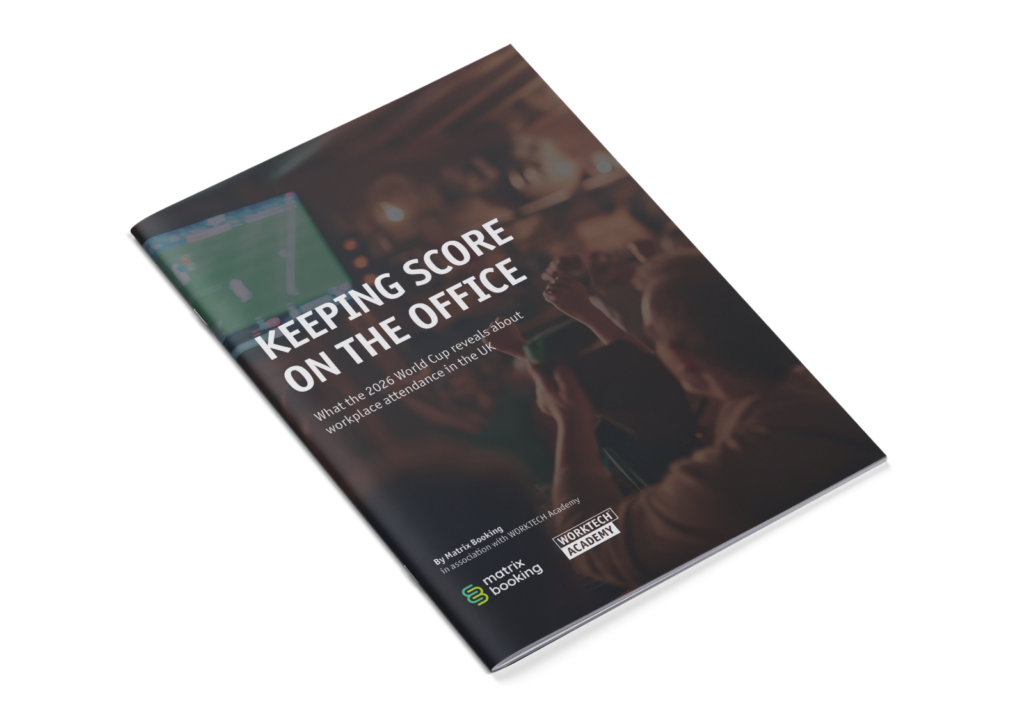
New research from Matrix Booking and WORKTECH Academy
Late-night England matches. Early morning starts. A workforce that has spent the past five years learning to modulate where and when it works. The 2026 World Cup is not just a sporting event; it is a practical test of how well your organisation’s flexibility policies hold up under real-world pressure.
This report, produced by Matrix Booking in association with WORKTECH Academy, draws on an independent survey of 2,000 UK office workers to examine what employers can expect during the tournament, and what the most forward-thinking organisations are already doing differently.
- Free to download.
- 2,000 workers surveyed.
- Independent research by OnePoll.
"*" indicates required fields
Matrix Booking uses the information provided to contact you about relevant content, products, and services. You may unsubscribe from these communications at any time. For more information, please read our Privacy Policy.
What the research found
of UK office workers say a late-night England match will affect how they work the next day.
of workers are more likely to come into the office if their employer shows the match there.
feel more positive about employers who offer flexibility around major sporting events.
The report also covers generational differences, a gender breakdown, regional variation, and a framework for turning the tournament into a template for future cultural moments.
Inside the report
The 2026 World Cup arrives at a specific moment for hybrid working. Most UK organisations have now settled into some version of a flexible model, but those models have rarely been tested by anything beyond the normal rhythms of the working week.
This section sets out why major cultural moments like the World Cup are different: they are a real-world check on whether flexibility policies actually work, or whether they just look good on paper. It frames the research and introduces the core argument, that how employers respond to the tournament will tell their people something they will not forget about the kind of organisation they work for.
We asked 2,000 UK office workers what they would actually do the day after a late-night England match. The results show a workforce that is already planning to adapt, and not always in ways employers expect.
The breakdown by age group is particularly striking. The gap between younger and older workers on almost every measure is large enough to have real consequences for organisations with a younger workforce. The full data is in the report.
Beyond the disruption story, the research surfaces a more encouraging finding about what happens when employers get the response right.
The data on how flexibility affects how people feel about their employer, and how that changes across different age groups, makes a strong case for taking a clear position before the tournament starts rather than waiting to react.
The most surprising finding in the research. The data points to what we have called the stadium effect, a clear pattern in how workers behave on match days that changes how you think about the link between workplace experience and flexible working.
The regional and gender breakdowns add further detail that is worth reading in full.
The World Cup ends. The questions it raises do not. This section uses the tournament as a way into a bigger conversation about how cultural moments are becoming a regular test of workplace flexibility, not a one-off.
It also looks at how the right tools can help organisations build an approach that works every time, rather than starting from scratch each time something like this comes around.
The report closes with five practical steps for workplace decision-makers, each one grounded in the research and ready to act on before the opening match.
They are built around a single argument: the organisations that handle the World Cup well will not just have got through a scheduling headache. They will have shown every person in their workforce, in a very concrete way, what kind of employer they actually are.
Who this report is for

Get ahead of the attendance patterns the tournament will create and use the data to make the case for more responsive space management.

See how the World Cup changes attendance patterns across regions, age groups and genders, and what that tells you about how people are using office space

Understand how your employees are likely to respond to the tournament and what it means for your flexibility policy.

Find out whether your flexibility policies hold up under real pressure, and what to do differently next time.
About the workplace flexibility research
Configurable workplace management software supporting flexible, hybrid working.
Global research platform helping organisations navigate the future of work.